
Moldova Stock Exchange
A stock exchange founded in December 1994, open for trading since 1995 and supervised by CNPF. Here we explain what it is, where it comes from, how the regulated market and the multilateral trading facility work, what is traded today and how it is accessed.
- What it is
- History
- Legal framework
- Regulated, MTF, OTF
- How to access it
- FAQ

What the Moldova Stock Exchange is
The Moldova Stock Exchange (BVM) is the operator of the regulated securities market of the Republic of Moldova. In short, it is the organized place where supply and demand meet for financial instruments such as shares, corporate bonds, and government securities, under clear admission and trading rules.
BVM operates under the authorization and supervision of the National Commission for Financial Markets (CNPF). It runs two trading venues — a regulated market and a multilateral trading facility (MTF) — which we detail below. Official information, statistics, and current listings are published on its own website, bvm.md.
Brief history
BVM was founded in December 1994, and the first trades took place on 26 June 1995 — the day considered the exchange's "birthday". 34 founders, professional participants in the securities market, took part in its establishment.
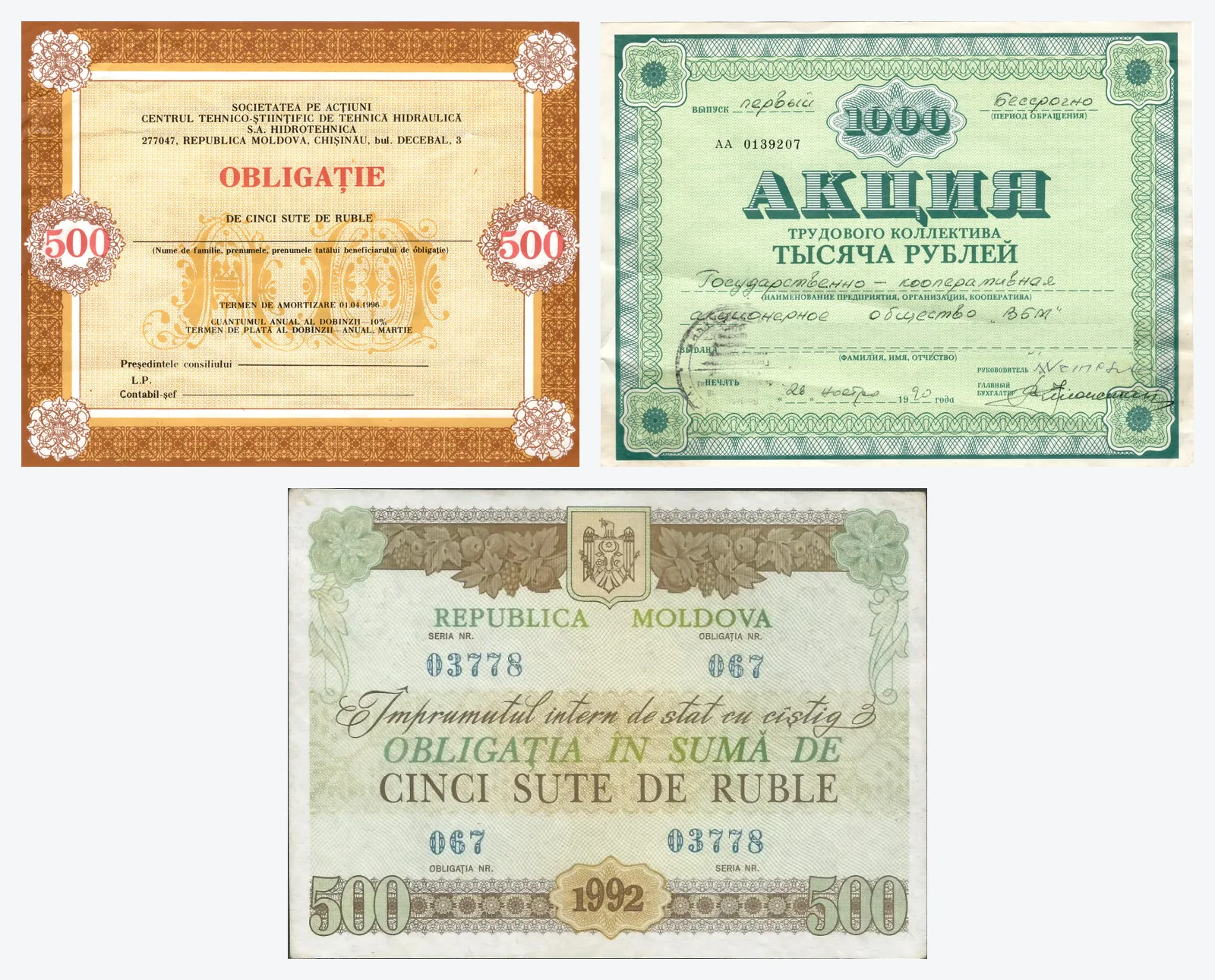
In its early years, the exchange was closely tied to the mass privatization process. Mass privatization based on patrimonial bonds created a large number of joint-stock companies (draft National Strategy for the Development of the Capital Market 2025–2030, version of 23 May 2025).
In March 2015, Law no. 171/2012 on the capital market entered fully into force, changing the market's structure and trading rules (BVM history). The number of issuers listed on the exchange fell from around 1.100 initially to 37, according to the draft Strategy (version of 23 May 2025). Share ownership is recorded in the shareholders' register: at the Single Central Securities Depository for banks, insurance companies and exchange-listed companies (art. 46 para. (3) of Law no. 234/2016), and at registrar companies for all other companies.
The regulated market, the MTF and what comes next (OTF)
Beyond the legacy of the past, here is how the exchange is organized today. The same institution runs two trading venues — the term used in European legislation for the organized place where trades are concluded — each with different rules, and the difference matters directly to you as an investor.
The regulated market
This is the trading venue with the strictest requirements. To admit shares, the BVM Regulated Market Rules (art. 25) require, among other things, a foreseeable market capitalization or own capital of at least the leu equivalent of one million euros and at least 10% of the shares of the same class in free circulation (free-float). Issuers have extensive transparency and reporting obligations. Traded here are shares, government securities, corporate bonds and municipal bonds (shares and bonds, BVM lists as of 11.09.2026).
The multilateral trading facility (MTF)
The MTF is a trading venue with more relaxed admission requirements, designed for companies that do not meet the regulated market's thresholds. Traded here are the shares of some joint-stock companies, some of them admitted provisionally, and municipal bonds (shares and bonds, BVM lists as of 11.09.2026). It is also supervised by CNPF, but offers issuers simpler access.
| Regulated market | MTF | |
|---|---|---|
| Admission requirements | Strict (capital, free-float, transparency) | Relaxed |
| For whom | Large issuers, banks, the state, local authorities | Smaller companies, town halls |
| What you find | Shares, government securities, corporate and municipal bonds | Shares of some joint-stock companies, municipal bonds |
| Supervision | CNPF — for both | |
What this means for you
Generally, you don't choose the trading venue yourself — you buy an instrument, and it is already listed on one of them. Still, the difference tells you two useful things before you buy: how many transparency obligations the issuer has and, as a rule, how easily you'll be able to sell it later. A share on the regulated market comes with a more transparent issuer and stricter rules; one on the MTF, with more relaxed requirements. Before you buy, check where the instrument is listed — on the regulated market or the MTF. It's a signal about what you're buying and what risk you're taking on.
Parliament has adopted, in second reading, the law on financial instrument markets and investment activities, aligned with European standards (MiFID II/MiFIR); according to CNPF, the new provisions enter into force six months after publication in the Official Gazette (CNPF communiqué, 2 September 2026). The draft submitted to the Government on 26 June 2026 introduces, among other new features, a third type of trading venue — the organized trading facility (OTF, Organised Trading Facility). Unlike the regulated market and the MTF, the OTF is intended for instruments that are not shares (for example bonds or derivatives) and gives the operator some discretion in executing orders.
Worth noting: the OTF does not appear automatically at BVM or at another existing operator. Under the draft of 26 June 2026 (art. 101), an OTF may be operated by investment firms and banks authorized by CNPF for this purpose, as well as by market operators running a regulated market, after CNPF authorization.
What is traded today
On the regulated market, the shares of a small number of companies are admitted; as of 11 September 2026, most of them were commercial banks and insurance companies. On the multilateral trading facility, the shares of other joint-stock companies are admitted, some of them provisionally, for a limited period.
The largest part consists of fixed-income instruments. On the regulated market, dozens of government securities issues from the Ministry of Finance are admitted, alongside corporate bond issues and municipal issues. On the multilateral facility, other municipal issues are admitted, from village halls. Up-to-date lists are published by BVM.
As of 16.10.2026. Source: BVM lists.
One indicator of the size of a stock market is market capitalization relative to gross domestic product — in other words, how much listed companies are worth compared with the country's economy. The Government's explanatory note of September 2025 showed that, over the previous two years, Moldova's market capitalization ranged between 3% and 7.7% of GDP, against 10–30% in Eastern Europe and an EU average of 65–75%. Up-to-date lists are published by BVM: shares on the regulated market, shares on the MTF, bonds on the regulated market, bonds on the MTF.
An initial public offering (IPO) is the moment a company sells its shares to the public for the first time, to raise money for growth. It is the basic function of an exchange: to channel financing from investors to companies.
The draft National Strategy for the Development of the Capital Market 2025–2030 (the Ministry of Finance version of 23 May 2025) shows that, after the 1994–1995 privatization programme, around 2.235 enterprises were privatized, but up to that point no share issue had been carried out through an initial public offering. Moldova's capital market was conceived in the early 1990s on the basis of a mass privatization programme (the same draft Strategy).
What this means for you
For an investor in Moldova, the local exchange today offers a limited number of instruments. That does not mean the local market is pointless: government securities, for example, remain an accessible, low-risk instrument, and the admission of corporate bonds shows a market that is moving.
For diversification and access to more liquid instruments, many investors also turn to regulated international markets. The choice depends on goals, time horizon, and risk tolerance — which is why education and a conversation with a specialist help before any decision.
Compare the options available locally, with the advantages and limits of each, on the page Invest in Moldova.
The legal framework and the capital requirement
BVM has held, since May 2015, the CNPF market-operator licence and the regulated-market authorization, and since November 2015 the multilateral-trading-facility authorization (BVM history). Law no. 171/2012 on the capital market sets the operating rules, including a minimum own-capital requirement of the equivalent of one million euros for the market operator (art. 61).
The deadline for BVM to comply with the minimum capital requirement, postponed by Laws no. 321/2022, 259/2024 and 177/2025, was 14.09.2026 (the Government's explanatory note). After that date BVM continued to hold sessions and publish announcements (BVM's latest session and announcements).
The capital requirement applies to the market operator — the company that runs the exchange — and is meant to ensure orderly operation and cover risks. It does not limit people's right to invest. Details on what is legally permitted in Moldova can be found on the page Legal trading in Moldova.
How you access BVM as an individual
Individuals do not trade directly on the exchange. Access is through an intermediary — an investment firm licensed by CNPF — which receives and transmits orders. The full list of intermediaries is published in the register of licensed entities on the CNPF website (the official source, not forums).
One thing to expect: at the local exchange, access through an intermediary is order-oriented, not built around a modern app with real-time charts.
How to choose an intermediary, how to open an account, and how to place your first order — the full mechanics, valid for all local investment options, are on the page Invest in Moldova. For government securities there is also a direct online channel, with its own mechanics, on eVMS.
Frequently asked questions
Yes. You don't trade directly on the exchange, but through an investment firm licensed by CNPF. The complete steps — how to choose the intermediary, how to open the account, and how to place the order — are on the page Invest in Moldova.
Disclaimer
The information on this page is for educational and informational purposes and does not constitute an investment recommendation or a tax or legal consultation. Investing in securities involves risks, including the liquidity risk specific to the local market. Figures on issuers and market capitalization may change over time; for up-to-date data consult official sources (CNPF, BVM).
Want to understand your real investment options?
Talk to a specialist about the local market and international ones, or start with the basics in a structured course.